

GEO vs SEO: What Is the Difference and Which Strategy Does Your Business Need?
Super Admin · Admin
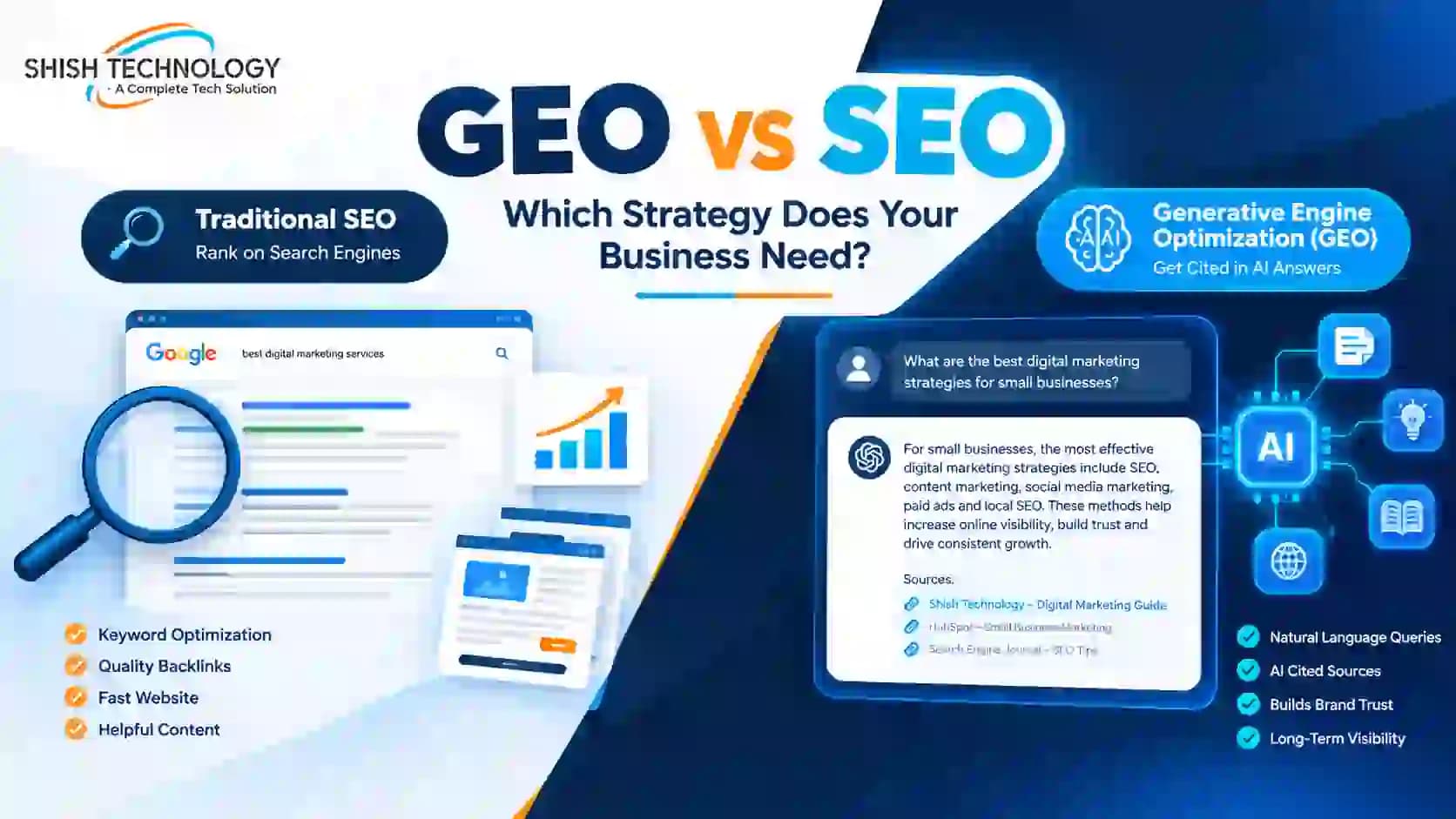
GEO vs SEO: What Is the Difference and Which Strategy Does Your Business Need?
GEO vs SEO is the biggest question business owners are asking today as the internet changes faster than ever before. For many years, getting your business to show up on Google was a very straightforward process. You simply used the right keywords, built good links, and people found your website. But suddenly, artificial intelligence has completely changed how people look for answers online. When users ask questions today, they do not just see a simple list of blue links. Instead, smart artificial intelligence tools like ChatGPT or Google AI Overviews read multiple websites and type out a direct, instant answer right on the screen. Because of this massive change, simply doing basic traditional marketing is no longer enough to win new customers.
In this very simple guide, we will openly explain the exact difference between GEO and SEO, how these two powerful systems actually work, and should businesses invest in GEO or SEO to protect their future profits. We will break down everything you need to know about preparing your business website for both traditional search engines and the new world of conversational artificial intelligence.
What is Traditional Search Engine Optimization?
Search Engine Optimization (SEO) has been the main strategy for digital marketing for the last twenty years. The main goal of traditional SEO is to make your specific website rank very high on a search engine like Google or Bing.
For decades, small local shops and massive global brands alike have spent large amounts of money to secure the number one spot on Google. Why? Because when a user actively searches for a service, they are already highly interested in buying. Being at the top of that list guarantees massive amounts of daily traffic.
When a customer goes to Google and types a phrase like "best laptop under 50000," traditional search optimization works to ensure your electronics store appears at the very top of the list. To win this traditional game, website owners focus on:
Using specific keywords naturally inside their page titles, headings, and text.
Getting other famous websites to link back to their pages.
Making sure their website loads very fast on mobile phones.
Creating helpful blog posts that answer everyday customer problems.
In the traditional SEO world, the final goal is to make the user click your link and visit your website. The website is the final destination where the customer takes action. However, traditional search relies heavily on the user doing the hard work. The user has to click multiple links and read several long articles to find their answer.
What is Generative Engine Optimization?
Generative Engine Optimization (GEO) is the brand-new future of online marketing. Instead of trying to rank your website in a long list of blue links, GEO focuses completely on AI-powered search engines and chatbots like ChatGPT, Perplexity, and Google's new AI search features.
When a user asks a smart AI chatbot a question, the AI does not just give them a list of links to click. Instead, the AI instantly reads hundreds of websites, thinks like a human, and types out a complete, direct answer.
Imagine a customer asking their mobile phone, "I have a budget of 50,000 rupees; what are the best laptops for college students with long battery life?" In the past, Google would simply show ten links. Now, generative AI acts like a highly intelligent digital assistant. It reads articles, watches reviews, and instantly writes a neat, helpful summary directly on the screen. If your business is mentioned in that helpful summary, the customer is incredibly likely to buy from you because the AI has already established deep trust.
The goal of GEO is to make sure the AI trusts your business so much that it uses your information and mentions your brand's name inside its direct answer. While traditional optimization aims for human clicks, AI SEO aims for machine trust so your company gets cited as an authoritative source.
The Main Difference Between GEO and SEO
Understanding the real difference between GEO and SEO is actually very simple if you look at their final goals. They are not enemies; they are just two different ways of reaching your customers.
Here is a simple comparison table to show exactly how they differ:
Feature | Traditional SEO | Generative Engine Optimization (GEO) |
Main Goal | Getting a high rank in a list of search results. | Getting your brand mentioned inside an AI-generated answer. |
How Users Ask | Typing short, simple keywords (e.g., "buy shoes online"). | Asking long, natural conversational questions (prompts). |
Role of Website | The website is the final destination for the user. | The website is a trusted source of information for the AI. |
How to Measure | Counting how many clicks and visitors come to the site. | Counting how many times AI chatbots cite and mention the brand. |
Content Focus | Repeating keywords and optimizing page tags. | Giving deep, highly factual, and clear answers to complex questions. |
Traditional search optimization focuses heavily on driving direct traffic to your web pages. Modern AI strategies focus on building deep trust so that intelligent machines recommend your business to users automatically.
Should Businesses Invest in GEO or SEO?
When business owners hear about these massive changes, their first question is always: should businesses invest in GEO or SEO?
The absolute truth is that you cannot choose just one. You absolutely need both! You should think of them as building a house. Traditional SEO is the strong, solid foundation of the house. If your website is broken, slow, or has very bad content, no AI machine will ever trust it.
GEO is the beautiful upper floor of the house. Once your traditional foundation is strong, you add GEO strategies to make sure smart AI tools extract your brilliant information and show it directly to modern users. If you ignore traditional search and only chase AI trends, your website will fail to build the deep technical authority that AI machines actually require before they cite you. Conversely, if you strictly stick only to old SEO methods, you will slowly watch your organic traffic dry up because modern users are getting their answers directly on the search page without ever clicking your link.
Practical Tips for Modern Search Optimization
You do not need to be a highly technical computer programmer to understand how to improve your website. Here are simple best practices for both traditional searches and modern AI recommendations:
1. Write for Humans, Not Just Machines
In the past, marketers used to stuff the same keyword into an article twenty times. Today, this old trick will actively destroy your business. AI machines want to read content that is highly valuable, deeply factual, and easy for a human to understand.
2. Structure Your Pages Clearly
AI tools act like speed readers. They love websites that are neat. You should heavily use clear bold headings, simple bullet-point lists, and well-organized tables so the AI can easily extract your facts.
3. Build Real Brand Authority
Generative AI tools only want to cite sources they fully trust. You build this trust by getting mentioned on other famous, high-quality websites and industry directories. The more the internet talks positively about your brand, the more the AI will recommend you.
Accelerate Your Growth with Shish Technology
Navigating the shift from traditional search to generative AI requires a partner who understands both technical website foundations and the latest machine-learning algorithms. This is where Shish Technology steps in. Recognized as the Best Digital Marketing Company in Patna, the agency provides end-to-end digital solutions designed to keep your business ahead of the curve.
Whether you need comprehensive Shish Technology SEO Services to secure top rankings on Google search result pages, or cutting-edge Shish Technology GEO Services to ensure AI engines cite your brand as an authority, our team delivers transparent, data-driven results. We handle the technical complexity so you can focus entirely on running your business.
Conclusion
The way people discover information on the internet is undergoing its biggest transformation in decades. Sticking exclusively to old search optimization methods leaves your business vulnerable as users turn to conversational AI for instant, synthesized answers. However, abandoning standard website fundamentals is just as risky, since generative engines rely on well-indexed, authoritative sources to formulate their recommendations. The smartest strategy for the future is not choosing between GEO or SEO, but combining them into a single, unified approach. When your brand masters both traditional search and generative engines, you ensure that potential customers find you no matter how or where they choose to search.
To successfully manage this complex transition without losing your current traffic, you need expert guidance that bridges the gap between old and new technologies. By partnering with the Best Digital Marketing Company in Patna, you can seamlessly integrate robust SEO Services and GEO Services. Take the smartest step for your company's future today, and let Shish Technology build a powerful, AI-ready digital presence that keeps your brand highly visible for years to come!
Frequently Asked Questions (FAQs)
When dealing with new technology, it is completely normal to have many questions. Here are the most common questions answered in very simple words:
1. What exactly is the main goal of GEO?
The main goal of GEO is to optimize your brand and website content so that smart artificial intelligence tools (like ChatGPT or Google AI Overviews) confidently mention, cite, and recommend your business when users ask them direct questions.
2. Will AI chatbots completely kill traditional SEO?
No, traditional SEO is not dead at all. Many people still prefer to see a list of websites so they can do their own shopping, read full reviews, or verify facts. AI search simply adds a powerful new layer of discovery. You still need traditional search optimization to keep your website healthy and visible.
3. Do I need to hire two completely different teams for GEO and SEO?
No, treating them as separate departments creates unnecessary confusion and extra costs. A smart, modern digital marketing agency will naturally blend both strategies together, using the same expert team to manage both your traditional rankings and your AI visibility.
4. How do I know if my GEO strategy is actually working?
Unlike traditional methods where you can easily check Google Analytics to count daily clicks, tracking AI success is slightly different. You measure success by asking conversational AI chatbots questions about your specific industry and tracking whether they cite your brand's name as a trusted source in their answers.


